
Financial Boundaries & Behavioral Risk Management: How to Say “No” and Protect Your Money

Introduction
Money stress isn’t just about math — it’s about behavior, boundaries, and emotions. While most people focus on budgeting or income, the real breakthroughs happen when you:
- Create internal boundaries (your rules)
- Use external boundaries (your communication shields)
- Practice behavioral financial risk management (protect yourself from emotional money decisions)
In this guide, you’ll learn how all three work together to give you clarity, confidence, and peace with your money.

Part 1: Internal Financial Boundaries
Internal boundaries are your mental safety nets for money. They’re personal rules you design to keep yourself aligned with your values.
Why Internal Boundaries Matter:
- Prevent impulse spending
- Reduce decision fatigue & stress
- Protect you from emotional money choices
- Build self-trust and long-term confidence
Examples of Internal Boundaries:
- The Pause before non-essential purchases (ie: Create Internal Thresholds of 24-hour, 48-hour, or week-long hold before making a non-essential purchase).
- “Does this align with my current priorities?”
- “I don’t shop when stressed or emotional”
- Creating a flex fund for special purchases
- “One in, one out” replacement rule
These aren’t meant to be restrictions — they’re tools for intentional living giving you full power over your purchases by integrating self-awareness with intentional spending.


Part 2: External Financial Boundaries
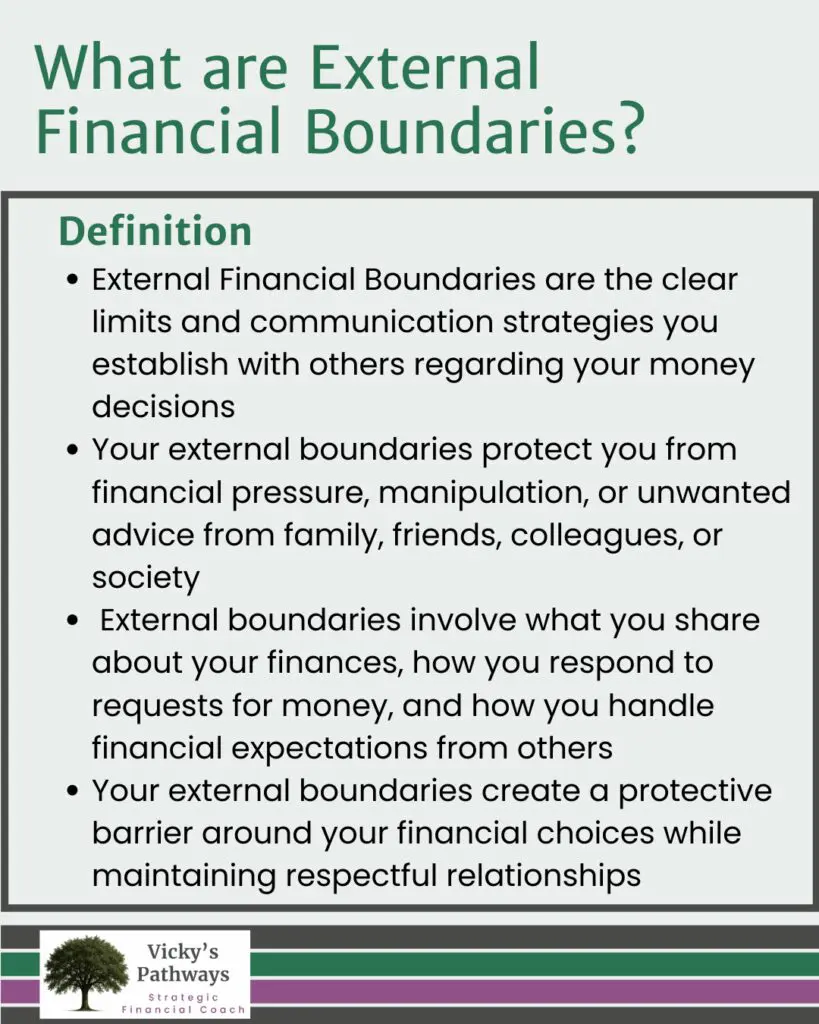
External boundaries are your communication shields. They protect your financial decisions from outside pressure, requests, and expectations while maintaining healthy relationships.
Why External Boundaries Matter:
- Shield you from guilt trips and manipulation
- Prevent others from derailing your goals
- Reduce stress from money-related social situations
- Build confidence in your financial communication
Examples of External Boundaries / Scripts:
- “That doesn’t work for my budget right now.”
- “I don’t make financial decisions on the spot.”
- “My budget for dinner out is $30—does that work?”
- “I’m not comfortable discussing my finances.”
- “I’ve already allocated my giving budget for this year.”
You can be kind, respectful, and firm with your money decisions. No long explanations required — just clear and simple communication.


Part 3: Behavioral Financial Risk Management
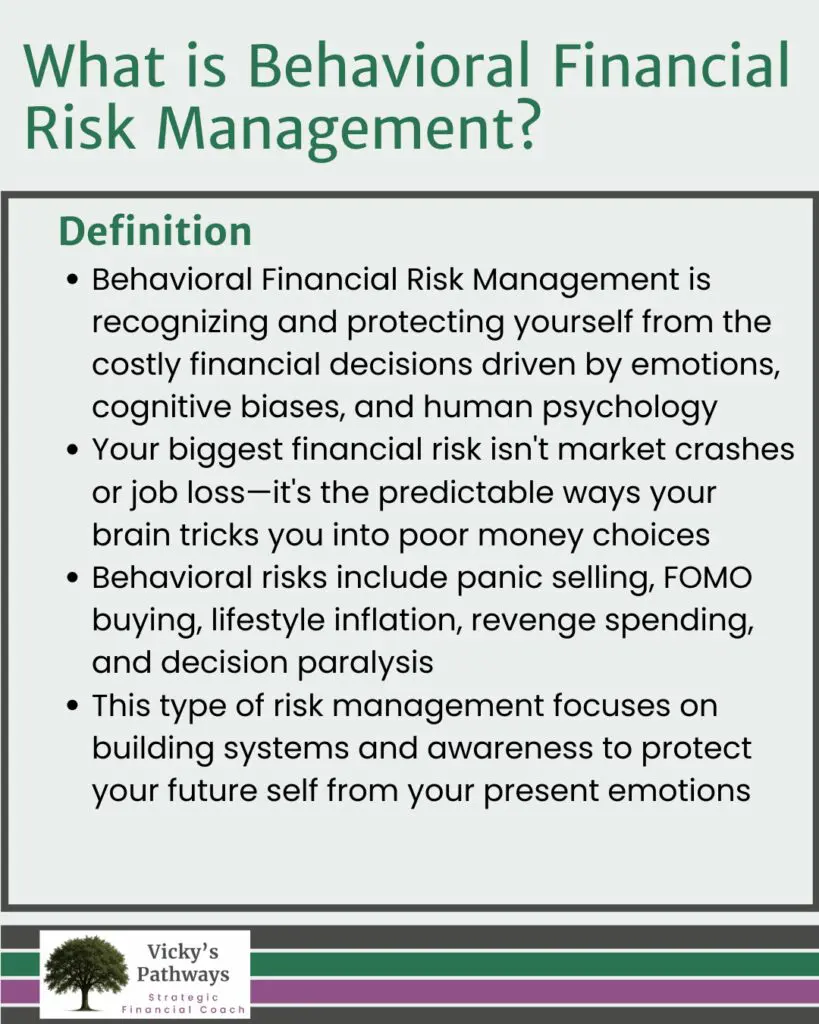
Even with great boundaries, your brain can still sabotage your financial progress. Behavioral Financial Risk Management means recognizing and protecting yourself from the costly money decisions driven by emotions, cognitive biases, and human psychology.
Your biggest financial risk isn’t market crashes or job loss — it’s the predictable ways your brain tricks you into poor money choices.
Examples of Behavioral Risks:
- Panic selling investments during market volatility
- FOMO buying or chasing “hot tips”
- Lifestyle inflation erasing raises or windfalls
- Revenge spending after setbacks
- Decision paralysis delaying important actions
Why This Matters:
- Emotional decisions cost the average investor 2–3% in returns annually. (nuwealthapp.com)
- FOMO and social pressure lead to purchases that don’t align with your values.
- Panic decisions lock in unnecessary losses.
- Revenge spending compounds financial problems.


Smart Systems to Protect Yourself
Work with your human nature, not against it. Try these strategies:
- Automate investments so emotions can’t interfere.
- Create a 48-hour rule for purchases over a certain amount.
- Set up “money dates” to review decisions when calm.
- Build in accountability partners for big financial choices.
- Create “if/then” scenarios before market volatility hits.
- Track your emotional spending triggers.
- Use the “past self / future self” decision framework.
Why Saying “No” Matters (Across All Three Areas)
Saying “No” is hard, but every time you do, you’re choosing what matters most — your priorities and your goals.
Every “yes” to one thing is an automatic “no” to something else. In the financial world this is commonly referred to as opportunity cost. It represents the benefits someone misses out on by choosing one option over another. For example, saying “yes” to overspending today means saying “no” to financial freedom tomorrow.
Boundaries + Behavioral Risk Management help you:
- Say no to impulse or emotional decisions.
- Say no to outside pressures and guilt trips.
- Say yes to your goals, your values, and your future self.
Scripts for When “No” Isn’t Working
Use these phrases when someone pushes past your boundary:
- “I’ve already given you my answer. Continuing to ask is disrespectful.”
- “My no wasn’t a negotiation starter—it was my final answer.”
- “I need you to respect my decision. Pushing isn’t going to change it.”
- “I understand you’re disappointed, but my answer remains no.”
- “Making me feel guilty about my financial boundaries isn’t okay.”
- “My financial decisions aren’t up for debate.”
- “We’ve discussed this before. I won’t be entertaining this conversation again.”
- “Since you can’t respect my no, I’m ending this conversation.”
- “I’m not discussing this further” + walk away/hang up/leave


Putting It All Together
- Internal Boundaries = Guide your decisions.
- External Boundaries = Communicate your decisions.
- Behavioral Risk Management = Protect yourself from your own emotions & behaviors.
Together, they create a complete system to protect your financial wellbeing and build a confident, intentional money life.
Words of Encouragement
You don’t have to do this perfectly. Every small boundary you set, every smart system you implement, and every time you pause before making a money decision is a win.
It’s the small, consistent actions that add up to big results. You’re not just managing money — you’re leading your financial life with intention and progress!
Ready to Take the Next Step?
If you’re ready to create healthy money habits and boundaries, I can help. Book a free coaching call with me here:
👉 Book Your Free Call
You don’t have to navigate this alone — together we can transform your relationship with money.
Closing
Boundaries aren’t walls — they’re bridges to the life you actually want. Protecting yourself from outside pressure and your own emotional decisions is the ultimate act of financial self-care.
Wishing you abundance & clarity,
Vicky Oberlander
Strategic Financial Coach
Vicky’s Pathways LLC